Sunday, August 16, 2015

Saturday, August 15, 2015 Ankles and Snakes


EARLY AUGUST ON OLD RAG
SATURDAY AUGUST 15, 2015
 
Flowers along the roads.


PREVENT SEARCH AND RESCUE
 
An ankle injury is loaded into the ambulance for transport.     Old Rag has many ankle injuries across the spectrum of severity.   After you leave the summit it is not unusual to relax.   The challenge is over.   It is time to think and talk about what fun stops you might make on the way home.   This is also a good time to remind yourself you still have a long hike out.  A good time to remind yourself that your body is tired and that you are apt to be less focused on the task at hand.  Climbing up meant gravity kept your speed and momentum more controlled while heading down means the opposite.   This is why the percentage of ankle strains and sprains is MUCH! higher for hikers going down the mountain than for hikers going up the mountain.    Reminding yourself of these thoughts before leaving the summit might be a good preventive measure.   The
best recues are the ones that never need to happen.


SNAKES MOVING AT NIGHT


The following two shots of Copperheads crossing the fire road were taken  forty minutes and two miles apart.   The first one was taken during fairly bright dusk conditions near PO Junction and the second was taken in night conditions about a half mile from the upper parking lot.    I had been looking off through the woods at a campsite and did not notice the first one until my lead footfall was about four feet from him.   The end of my next pace had a likelihood  of landing my foot on this fellow.  From his coloration it looks like he may be getting ready to shed.   Snakes can be a little bit grumpier when they are in this condition.     It is not a good idea to be walking around at night without some type of light when SNP snakes are active.   Make sure you are watching were you put your feet, hands, or other body parts when in the SNP backcountry.


Thursday, August 13, 2015

PATC Trail Patrol with Sarah Fairchild Look


Sat. & Sun. August 8&9, 2015

On Saturday I did a PATC Trail Patrol on Old Rag accompanied by my oldest daughter, Sarah Fairchild Look.   I was very surprised to see that the parking lot had obviously filled earlier in the day because there were a very large number of cars in neighbors pasture.    I am not used to seeing this type of turn out in the summer heat.     On Sunday I arrived at the parking lot around 3 PM and did a long slow walk with lots of stops for interpretation up the fire road to PO Junction and back. 

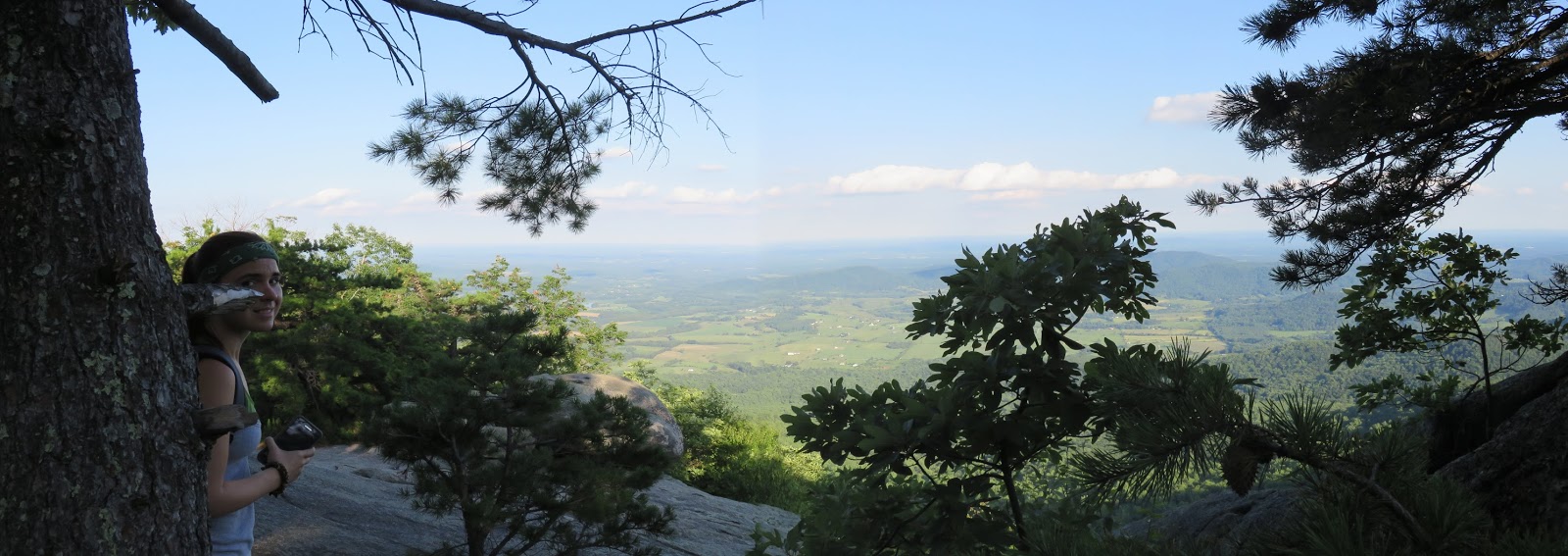
The next three pictures are all taken from the first false summit at the beginning of the rock scramble:


Appalachian Trail Coference Biennial Meeting


TWO OLD RAG HIKES LED FOR
THE APPALACHIAN TRAIL CONFERENCE'S
BIENNIAL MEETING 2015
Sunday, June 19, 2015 & Wednesday, June 22, 2015

After helping with the ATC Biennial Meeting 2015's LNT booth on Friday & Thursday I led interpretive hikes on Old Rag.


Wednesday's Group

Sunday's Group


Two pictures of Wednesday's group on the summit.


Below are some of the interpretive talking point notes I researched and wrote down for myself for the hikes:


LOCATION DISCUSSION POINTS
Parking Lot Ranger Contact Station

Introductions, Group Management Understandings, 
PATC Old Rag Cabin

Discussion about the history of this new cabin.  Laurie Burch Hancock MD, 1878 log cabin.  The 135 year old cabin had been occupied until 1990.  PATC's John Corwith recommended it be moved to 25.3 acre lot here near Old Rag.  
PATC New Old Rag Parking Lot

Discussion about the current Old Rag parking lot and the potentially new Old Rag Parking Lots.
PATC Blue Barrel Hunt Club

Discussion about Old Rag Granite being according to scientist the oldest rock in the park (perhaps Virginia) at 1.3 Billion years old.    If you let one inch represent 2,000 years and do the  math you will find you need 650,000 inches or around 10.29 miles to represent the 1.3 Billion years.   Our hike today will be around 9.1 miles so if you let an inch represent 2,000 years you would need todays hike and 1.2 additional miles to represent the 1.3 billion year age of Old Rag Granite.    Most of the rock along Skyline drive dates back around 250-300 million years to the late Paleozoic.
Nicholson Hollow Trail


Nicholson Hollow Trail, First Half Mile Private Land, Travels Up To Historic Corbin Cabin and Through the Free State Hollow ruled by King Aaron Nicholson 1832-1911, owned 241 acres, and called his home his castle.   The King and his second wife Alice Storther left the hollow when other Nicholson women tried to poison her.     Nicholson's decendents were paid $783 for 20 acres a 15-43 foot log home, a sizeable barn, two out buildings and an acre of orchards.  Story of meeting  George Corbin's great grand daughter.  The original Corbin to settle in Nicholson hollow around 1816 after serving in the War of 1812.   Eventually this Corbin was killed by a Nicholson over a moonshine issue leaving a wife and seventeen children.     One of his decendents George T. Corbin erected Corbin Cabin in 1910 and lived in it until 1938.    This cabin is in the register of historic buildings.   It is maintained to remain historically authentic and can be rented by PATC.   It was saved by NPS firefighters during the 2000 forest fire.
Upper Lot

Some history about the park.  Authorized in 1926 fully established in 1935.   Original planned called for the purchase of 521,000 acres.  Budgets forced two downsizings to 163,000 acre purchase. Park is now 199,000 acres of which about 40% or 79,0000 acres is designated as National Wilderness.
Large Granite Boulder 
Colluviall transport, frost heave creeping downhill
Start Of Switch Backs

The early SNP trails often went directly the mountain resulting in erosion.   The lowere part of the Old Rag Ridge Trail was rebuilt with many switchbacks sometime in the last 40 years.
R7

Discussion about the numbered blue blazes.
First Views 
Discussion of mama bear and two cubs of four years ago
Bartenders Spring

Named after the Bartenders PATC trail crew
Trillium Field

Discussion of; Trillium field (SNP's signature flower), now downed and cut up huge widow maker.
No Camping Sign View Point

Discussion of the new rule making everything above 2,800 foot elevation a no camping zone.
First False Summit R20

Point out Weakley, Corbin and Nicholson Hollows, Skyline Drive, Home across from Old Rag Cottage, Etlan
Quaking Aspens

Point out Quaking Aspens which are a rare species for SNP (not rare out West).


Boulder Cave


Very large rattlesnake story.
Trundled Boulder 

Discuss the fact that this boulder was trundled into crevice.  Old (30-40 years ago) do not show the rock.   The stair like base of the crevice is a good example of columnar joints similar to the hexagonal shapes of devils tower or also found in certain parts of SNP.
Atlis aka Whale Rock

Story of fraternity gathered on top out near the end jumping up and down joking about seeing if they could get the rock to detach
Climbing Routes Below Chute

Point out the climbing protection located about 15-20 feet up on the granite wall just before the start of the chute.
Chute

Discuss the alterations done in the Chute to limit the backups that occur at the Chute in the Fall
Dumb As A Box Of Rocks Boulder

Really good example of spheroidal errosion.
Skyline aka PATC Wall

Discuss the name of the climbing wall/cliffs.  Point out Mt Robertson.   Discuss the fact that Edward Dyer who arrived in 1863 had 100 peach trees on the summit of Robertson in the early 1900s, William Dyer (son of Edward)  says that there was a time when two thirds of the north side of Robertson Mountain were apple orchards.   In addition Weakley Hollow had hundreds of acres of apple orchards.
Summit Spring

Discuss the SNP Rock Outcrop Management Plan (ROMP).   Outcrops often both fragile, unique microsystems and popular destinations.
Leap Of Faith

Discuss American fairly large Chestnut Trees around 30 feet from this spot.
Summit

Discuss Opferkessels(sacrificial basin, armchair hollows, weathering pans, solution pans or pits.   They can contain vernal pools that Old Rag tree frogs use for egg laying.     Island in the sky unique micro-ecosystem.
View of Hollywood climb 

Old PATC films made about Washington area rock climbing in the late 1940's and 50's.  Google PATC History of DC Climbing parts 1 through 7 or Potomac Mountain Club The Historic UpRope Videos.  Parts 4 and 5 filmed on Old Rag Mountain.     
Secondary Summit

Fire Tower built       During Fall 1930 11,428 acres burned on Old Rag Mountain. Fire Tower was built December 1943 and removed in 1959.     In 1978 445 acres of Old Rag Mountain burned.  In 2000 16,000 acres of SNP burned in two simultaneous fires at Old Rag(suspected arson) and Pinnacles(campfire).
View of Saddle White Oak Canyon

Point out Mt Robertson, Weakley Hollow, White Oak Canyon, Cedar Run, Hawksbill Mt., Skyline Drive
Byrds Nest Shelter

Harry F. Byrd Sr. 1887-1966(father) Harry F Byrd Jr. 1914-2013(son)  Richard E. Byrd 1888-1957 (brother and uncle)  The Byrds gave Byrds Nest 1-4 to the SNP.   No relation to WV Robert Byrd.    Harry F. Byrd Sr. was descendant of one of the first Virginia Families and was related to William Byrd II,  Robert "King" Carter of Corotoman(a colonial governor) and Pocahontas.   He was elected 50th Govenor of Viginia in 1925 and served as a US Senator from 1933-1965.    The Byrds' were huge supporters of and loved hiking in SNP.    .  Of note he advocated for "Sothern Manifesto" and "Massive Resistance" to Federally ordered school desegregation between 1959 and 1964.    The state voucher set up after the federally ordered desegregation started allowed white students to attend private segregated schools was eventually deemed as an illegal means to circumvent the ordered segregation of Virginias publid schools. 
Lady Slippers 
Show and discuss the rare large cluster of Lady Slippers.  Discuss the symbiotic relationship with a fungus that makes Lady Slippers almost impossible to transplant and the fact that the Smokies used to have many examples of Lady Slippers within sight of the trails but they are almost all gone now because folks have tried to poach them for their backyards without an understanding that they almost certainly will die. 
Last Open Views 

Take a short break at the last open views before plunging under the canopy.

       
CCC Stairs The CCC was a public work relief program form 1933-1942.  The first two CCC camps (NP-1 and NP-2) in national parks were at Skyland and Big Meadows.    There were 10 CCC camps in or on land adjacent to SNP.  These stairs were installed by the CCC.
Old Rag Shelter 

Point out the spring below Old Rag Shelter take a short break.

Old Cemetery Berry family cemetery.    Ashby Berry, Edna Barry, three year od Bertha Berry, three other Berry sisters 18 all together.   John Butlers store was located just below the cemetery.
PO Junction and Old Rag Village
The Old Rag Post Office was established March 19, 1919 and it was closed November 15, 1935.   It was operated by Wiliam Austin Brown.  John Butler's store was a short distance from the Post Office and a Church that also served as a school was across the street. 
18 Cabins of Weakley Hollow

The 18 Cabins of Old Rag -- A Field Guide for Bushwackers by Len Wheat
Old Weakley Hollow Road
Point out the old road that used to service Weakly Hollow before the fire road route 601 was built.
Mt Robertson Trail Head

Point out the Mt Robertson Trail Head
Acid Rain Test Well

If I can remember stop as we pass the old acid rain test well just off Weakley Hollow fire road point it out.
Corbin Hollow Trail Head

Point out Corbin Hollow trail head discuss some of the history of this Hollow versus Weakley and Nicholoson
Some of the sources used for reference. Shenandoah A Story of Conservation and Betrayel by Sue Eisenfeld, Old Rag Mountain Rebirth Of Wilderness by  Henry W. Bashore, The Undying Past of Shenandoah National Park by Darwin Lambert, In The Shadow of Ragged Mountain by Audrey J. Horning,  Hollow Folk by Mandel Sherman and Thomas Henry


Wednesday, June 17, 2015

June 13&14, 2015 LNT Trainers Course

Guy W. and I train 6 new LNT Trainers

Getting ready for our two days of backpacking and LNT classes.


Each student presents a lesson on one of the LNT principals and each student provides a constructive critiques of another students lesson.    Helpful hints and suggestions are provided by all.


While the class does cover learning the LNT subject matter it is mostly about teaching and training methods that can be used to teach the LNT subject matter.

The end of a great class.


June 3, 2015 PATC Trail Patrol One-on-One Training

The following pictures are from the day I did PATC Trail Patrol new member training for Greg F.
.


The following signage located at the intersection of Old Rag, Weakley Hollow, and Berry Hollow fire roads AKA PO Junction shows all the area interior to the area bounded by Weakley Hollow Fire Road, the Ridge Trail and the Saddle Trail to be a NO CAMPING AREA.     I do not believe this signage is correct but until it is fixed folks may want to play it safe and abide by it.    If I see any SNP published information that says that it is incorrect I will post it on my blog but in the meantime it is what is being displayed at SNP's PO Junction information display.

May 29, 2015 Memorial Day Weekend

The following pictures are from an Old Rag hike on Memorial Day weekend.


There is a spot where you can see as many as 100 Lady Slippers blooming.   Please note, Lady Slippers are dependent on a fungus do not survive transplantation.   You should not be taking anything from the park but it is especially pointless if you think you will be able to transplant this particular species.

The following is taken from a very reputable commercial nursery Vermont LadySlipper Company   http://www.vtladyslipper.com/vtlscwebpg11.html   that raises and sells Lady Slippers

Q.I've heard that you need a special mycorrhyzae fungus in your soil to grow these . Is this true?

Cypripediums, like all orchids, begin their life cycle when their seed (pro-embryo) is invaded by a microscopic fungus (endophyte). Since orchid seed has no endosperm (stored starch reserves that kick start most other plant species), the fungus in essence forms a surrogate root system for the seed.
If the soil nutrient levels and pH are correct, the fungus becomes a symbiont and provides small amounts of carbohydrates to the growing seed(protocorm). This is a very delicate process whereby the fungus infiltrates the growing orchid seed to a certain stage and then the orchid seed defensively responds by producing a group of chemicals that actually dissolves the fungal filaments back.
After having its filaments dissolved, the fungus will then reattempt to invade the protocorm and supply more carbohydrates and the protocorm will grow again ever so slightly. This process is repeated until the protocorm has grown large enough to produce a small dormant eye bud and root system (seedling). Once this occurs, the following spring the cypripedium will produce it's first green leaf and begin to use photosynthesis as its primary energy source. Once the seedling relies on photosynthesis, the cypripedium will reject the micro-fungus almost completely. This heterotrophic phase can take anywhere from 3 to 7 years to occur in nature. It can take an additional 5 to 10 years to reach flowering size which means the Cypripedium can take anywhere between 10 to 17 years to bloom, in the wild, from initial seed dispersion!

This above heterotrophic growth sequence only occurs when all the habitat and soil conditions are right. This is the primary reason for the natural rarity of cypripediums and not that the fungal symbiont they use is rare. Indeed, under many soil conditions, the fungus that the orchid requires can become a pathogen and destroy the orchid seed. There are several micro-fungi that have been isolated in cypripedium roots and the truth is that there are probably many more that could perform the symbiotic function given the right soil conditions.
Adult cypripediums do not require this fungus. We know this as a fact because we have grown 10's of thousands at Vermont Ladyslipper Company without it. We germinate the seed and grow the seedling in sterile agar cultures with plant nutrients and sugars to completely bypass the fungus requirement in infancy. These are the same techniques that are presently being used to produce large commercial quantities of tropical orchids.

Therefore, if you have a healthy adult cypripedium (Many for sale at Vermont Ladyslipper Company of Course!) and know the soil and pH requirements for the species in question, you can grow any cypripedium successfully in a garden without it's corresponding micro-fungus.
All this being said though, it is still of the utmost importance for all gardeners to do what they can to save what remains of natural cypripedium habitat so the genus can survive into the future. At this point the world needs to save and actually repair what has been lost of our natural environments. Orchids are wonderful indicator species to show us how much still needs to be done. Therefore,we are actively encouraging people to attempt to start new colonies in promising habitats with our plants that may reproduce naturally and actually BOOST the number of Cypripediums. We believe that we can actually stop and reverse the decline of this genus by applying our knowledge base and production techniques. 


Take about warts on Witch Hazel.
Soon to be yummy ripe blueberries.
The famous Old Rag Mountain Stewards.   Helpers of hikers.  Walking encyclopedias of Old Rag culture, history, flora, fauna, geology.....   Wurlitzers of backcountry knowledge, lore, and information.   Minstrels, magicians, tellers of tall tales.   On the busiest weekends of Spring and Fall look for these friendly volunteers with their signature orange shirts and black trillium logo.   Someone in their group usually has a park radio in the event of their needing to respond to a medical emergency on the Old Rag.   For more information check out their blog:     http://oldragmountainsteward.blogspot.com/


Pinxters or Mountain Azaleas

May 16, 2015 PATC Trail Patrol One-on-One Training

A new ranger.
Judy S. the PATC Trail Patrol new member who I provided one-on-one training to this weekend.